
Reducing Public Speaking Anxiety: First, Master the Mechanics
Apr 22, 2026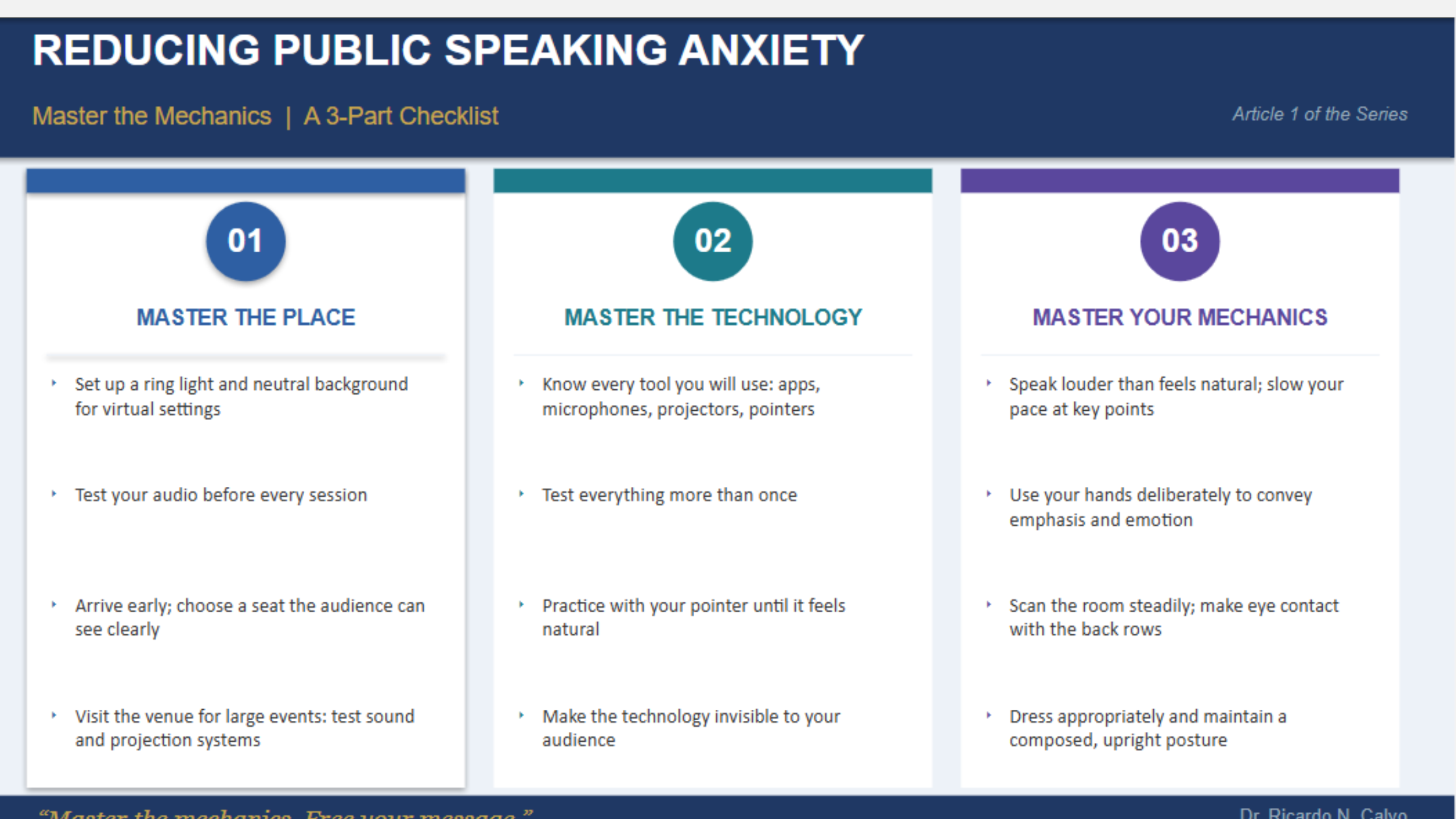
Written by Dr. Ricardo N. Calvo one of the amazing coaches in our Trusted Coaches Network. Learn more about him and his approach to coaching here.
Public speaking anxiety is one of the most common fears professionals face. After years of coaching individuals and teams, I have come to believe that a large part of that anxiety does not stem from stage fright or lack of confidence. It comes from something far more fixable: not having mastered the mechanical aspects of the craft.
Public speaking takes many forms, from a routine Zoom check-in with your team to delivering a keynote before hundreds of people. Regardless of the setting, the mechanics are largely the same. Once you make them second nature, you free your mind to focus on what actually matters: your message.
This is the first in a series of articles aimed especially at junior professionals beginning to navigate public speaking situations in professional settings. Think of what follows as a practical checklist you can carry with you. I organize it around three areas: the place, the technology, and you.
📍Master the Place
Your environment shapes your performance before you say a word. For virtual meetings, start with lighting: a small ring light positioned in front of you makes a surprising difference in how professional and present you appear. Minimize distractions in your background: blur it or use a neutral backdrop and always test your audio beforehand. A dropped connection or muffled voice breaks momentum and rattles confidence.
For in-person team or project meetings, arrive early. Familiarize yourself with the room layout and choose a seat where the audience can see both you and the projected content without turning their heads. Small adjustments like this signal preparation and put you at ease.
For larger events, do a full venue visit beforehand. Walk the space, visualize the room filled with people, test the sound and projection systems, and do not hesitate to ask for adjustments. Knowing the space removes one major source of the unknown.
🖥 Master the Technology
Technology fails at the worst possible moments, unless you have tested it thoroughly. Before any presentation, take stock of every tool you will use: the video conferencing platform, the projector and display system, the microphone, the presentation software, and any audience engagement tools such as Mentimeter or live polling apps.
Test everything. Then test it again. If you plan to use a pointer: whether physical, such as a telescoping stick, a laser pointer, or a mouse cursor on screen, practice using it smoothly. An awkward, wandering pointer distracts your audience and can undercut an otherwise strong delivery.
The goal is to reach a state where the technology is invisible, a transparent layer between you and your audience rather than a source of suspense.
🎤 Master Your Own Mechanics
This is where many speakers invest too little attention, often because it feels awkward to think of yourself as a performer. But public speaking is, in important ways, more like acting than conversation. You are projecting a message, and your physical presence either supports or undermines it.
Voice. Practice speaking louder than feels natural. Well-meaning coaches sometimes say “just be yourself”, but if your natural voice is soft, that advice can leave people straining to hear you. Volume conveys authority.
Hands and Pacing. Use your hands deliberately. If nervous gestures are a concern, hold a pen or similar object to give your hands a physical anchor. Over time, develop a small repertoire of intentional gestures that help you convey emphasis and emotion. Purposeful movement draws attention; fidgeting distracts from it. Be deliberate with your pacing: slow down more than you think you need to, especially at key points.
Eye contact. Scan the room at a steady, unhurried pace. Avoid locking onto any single person for too long. In larger settings, making eye contact with the back of the room creates a sense of connection with the entire audience, even those sitting in the front rows.
Dress and posture. Dress appropriately for the occasion: when in doubt, dress slightly more formal than the audience. Whether sitting or standing, maintain a straight, composed posture. How you carry yourself tells the audience how to receive you before you have said a word.
🎯 The Payoff: Freedom to Focus on What Matters
None of these behaviors is complicated. All of them are learnable. And when you practice them consistently, they become automatic, which is exactly the point. The less mental energy you spend managing the mechanics, the more you have available for the substance of what you are saying.
Anxiety thrives in uncertainty. Master the place, the technology, and your own physical presence, and you eliminate a great deal of that uncertainty. What remains is the part no checklist can hand you, but that becomes much easier to reach once the mechanics are out of the way: a clear, compelling message, delivered with conviction.
That is what we will explore in future articles.
