
You Belong at the Table: What Women in Environmental Careers Need to Know About Advocating for Themselves
Jun 06, 2026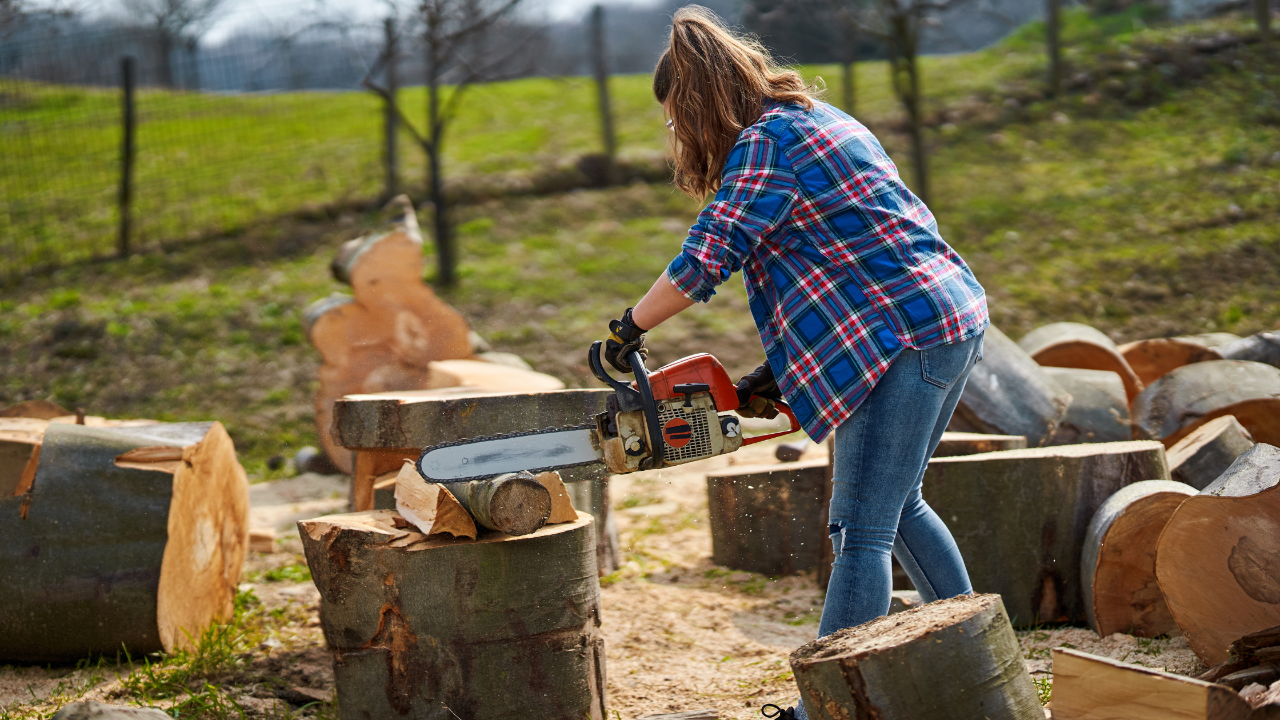
By Dr. Lauren Watkins, Environmental Psychologist & Career Coach
I was in a cherry picker running a chainsaw.
It was a tree-trimming field project with the kind of outdoor, hands-on work I loved. I was in charge of the team (all men except me) because I was the only one chainsaw-certified. I required everyone to wear proper protective gear and follow certain best practices. Not to be difficult, but because we were operating heavy equipment in an active work zone, and that is how it is done safely.
Some of them pushed back on my rules, grumbled, or rolled their eyes as they put on chainsaw chaps. Others made jokes. Some stayed quiet. One pointed out that no one had ever made them do this before. None stood up for me.
One of them even dragged a lawn chair over and planted himself a few feet away, watching me from the ground, smiling and joking inappropriately, calling out commentary as if I were putting on a show for him. "Never seen a woman run a chainsaw before," he said, “Guess I'd better pull up a chair for this one.”
I kept working.
At one point, I looked over at the man in the lawn chair and said something along the lines of: "I have more experience with this equipment than most of the people on this site. The PPE [personal protective equipment] is not optional. You can watch if you want, so you can learn how to do things correctly, but you will be wearing PPE."
He was not amused. Neither was I. I managed not to let it show, but I was shaking inside with a bit with a mix of disbelief, rage, and nerves with having to call him out.
That day, one of the men who had resisted wearing his chaps came very close to cutting his leg wide open. The chaps saved his leg.
Later, I went to my male supervisor and told him that the crew's reaction had been inappropriate and that we needed a more professional approach to dangerous fieldwork. It was not a complaint. It was a statement of fact delivered by someone who knew she was right.
After that, we created safety policies, they took the chainsaw safety course, they stopped joking, and they wore the PPE.
I was furious for a while. I was also right, and I knew it. That combination of knowing you are right and having to fight to be heard anyway is something many women, whether leading a field crew, supervising from the office, or managing a team, in the environmental field know intimately.
The Gap We Need to Talk About
Women are making real progress in environmental and sustainability careers. Data from GreenBiz shows that women now make up 63% of sustainability executives — a remarkable shift from just 17% in 2015. By many measures, this field has become one of the more welcoming spaces for women in leadership.
However, research on women in environmental NGOs tells a more complicated story.
Women in conservation and environmental organizations consistently report salary inequality, informal exclusion from decision-making, persistent challenges to their credibility and authority, and being passed over for promotion in favor of less qualified male colleagues. Women of color experience these barriers more acutely.
The renewable energy sector, where women make up about a third of the workforce, still sees women holding only around 10% of executive positions.
In other words, women are very present in this field. Women are doing excellent work in this field. And women are still fighting, in ways large and small, to be heard, compensated fairly, and taken seriously within it.
The lawn chair is still out there. It just takes different forms.
Why Self-Advocacy Feels So Hard in This Field
Here is something I have noticed in my coaching work that I think deserves to be said directly: the environmental field has a culture that can make self-advocacy feel uncomfortable in a very particular way.
This is a mission-driven space. People come to it because they care about the land, about wildlife, about communities, about the future. That values-driven culture is one of the things that makes it special, but it can also create an environment in which advocating for yourself feels at odds with the mission.
Asking for a raise or pushing for a promotion can feel less noble than focusing on the mission. Speaking up about how you are being treated can feel like a distraction from what ‘really matters.’
It is not a distraction. It is the work.
Research on women in environmental organizations points to a pattern I recognize from my own career and from conversations with clients: women in this space tend to lead collaboratively, to center community, to integrate social justice with environmental goals. These are genuine strengths, and they are also strengths that traditional organizational hierarchies are not always designed to reward, or even recognize.
Women also tend to wait to be noticed. To over-prepare before speaking up. To apply for roles only when they meet 100% of the listed qualifications, while our male colleagues apply at 60%. To downplay accomplishments in performance reviews because it feels like bragging.
None of this is weakness. It is the result of years of operating in environments that gave mixed signals about what was acceptable — and in some cases, actively penalized confidence.
But waiting and hedging our value has a real cost.
What Actually Helps: Advocating for Yourself Without Losing Yourself
The good news is that self-advocacy is a skill. It can be learned, practiced, and refined. And in a field as complex and interconnected as the environmental sector, it is also a strategic necessity.
Here is what I have seen make a real difference:
- Know your real barriers from your perceived ones. I work with clients on this all the time. A real barrier is concrete: a credential gap, a geographic constraint, a genuinely limited budget for raises. A perceived barrier is a story we tell that feels true but might be rooted in fear rather than fact: I am not senior enough, the timing is not right, they will think I am difficult. Learning to tell the difference (and create a plan accordingly) is one of the most useful things you can do for your career.
- Build your network before you need it. Research on women in environmental leadership consistently points to informal networks as one of the most critical supports, and one of the most unequally distributed. Women are more likely to be excluded from the informal conversations where decisions actually get made. The antidote is not to wait to be included. It is about building relationships proactively across organizations, sectors, and career levels. Not just mentors - more like sponsors or advocates. People who will root for you in rooms you are not in.
- Document your wins. Out loud. This is harder than it sounds, particularly in a field where the instinct is to center the mission rather than yourself. But if you do not make your contributions visible, no one else will do it for you. Keep track of what you have delivered, what you have led, and what would not have happened without you. Bring that record to performance reviews. Bring it to salary negotiations. Bring it into the room.
- Say what you want directly. Not as a hint. Not as a question framed as an apology. As a clear, grounded statement. I am ready for more responsibility. I would like to be considered for this role. I want to revisit my compensation. The research on women and negotiation is clear: women who advocate directly for themselves can face more pushback than men do. That is real. It is also not a reason to stay quiet. It is a reason to prepare, to practice, and to go in anyway.
- Address what is happening when it is happening. I did not ignore what happened on that field project. I named it to my supervisor that day, clearly and without drama, as a professional concern. I did not wait to see if things would improve on their own. That directness matters. Not every situation will resolve the way mine did, but staying silent rarely improves things either. It could also cause someone to lose their leg. (Side note: A book I really like on this bullet point is called Radical Candor by Kim Scott.)
You Do Not Have to Carry This Alone
The structural barriers that women face in the environmental field are real. They are not your fault, and they are not fully within your control. What is within your control is how you navigate them with strategy, clarity, and support.
That is the work I do with clients. We look honestly at what is holding you back, separate the real from the perceived, and build a concrete plan for moving forward. Whether you are trying to negotiate a raise, step into leadership, make a sector pivot, or simply figure out why you keep getting passed over, you deserve guidance that is specific to this field and honest about how it actually works.
The field needs your leadership. The question is whether you are positioning yourself to actually exercise it.
Dr. Lauren Watkins is an environmental psychologist and career coach with over 15 years of cross-sector experience in government, nonprofit, consulting, and academia. She works with environmental professionals navigating transitions, leadership growth, and sector pivots through The Environmental Career Coach network.
